Heptad
Origins
According to legend the Heptad has existed since the Dawn Age. It is said that in the first days of human civilization seven deities appeared to guide humanity in family, justice, creation and cultivation. Their presence became the spiritual foundation that endured through all later Ages.
Overview
The Heptad is a polytheistic religion based on a council of seven deities. Decisions are made through deliberation and majority vote as an example of balance and collective responsibility.
Common names include The Heptads, Council of the Seven, Seven Gods, while in formal texts the term Heptad Concord is used.
Deities
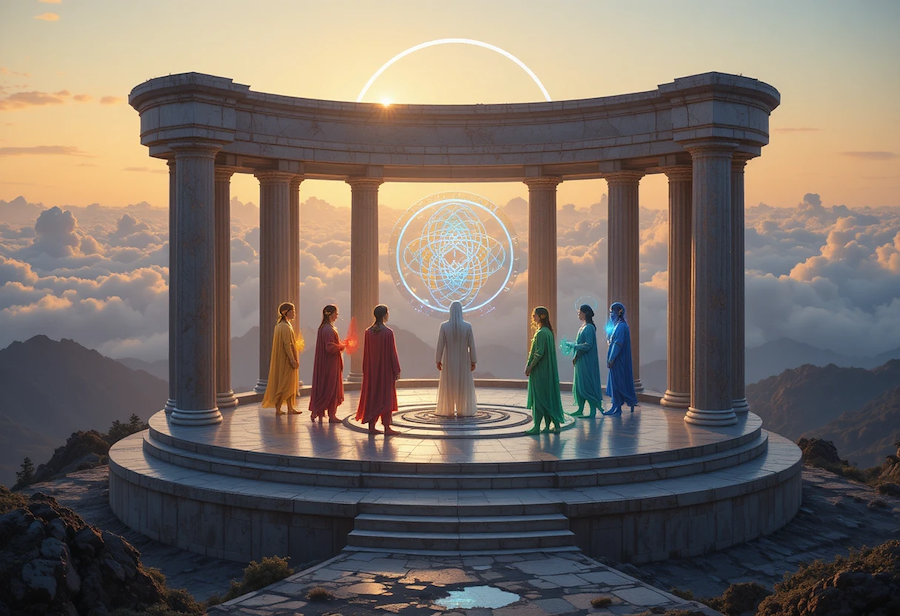
- Orvan, god of war and valor.
- Calveris, god of trade and travel.
- Deymar, god of technology and creation.
- Lythara, goddess of community, family and fertility.
- Serene, goddess of wisdom and justice.
- Miravel, goddess of nature, rivers and cultivation, her sacred gifts are the Miravels.
- Veyla, an androgynous entity embodying inspiration and dream, considered a bridge between mortals and the divine.
Symbols
- The Sevenfold Knot.
- Seven colors for ceremonies of full worship, variations of a single color for rites dedicated to specific deities.
Hierarchy and Clergy
There is no supreme father god, the deities form a Council that decides by majority. Priests serve in temples and interpret doctrine, monks and nuns live in monasteries, cultivate the land, study and practice spiritual discipline. The training of priests is strict and includes memorization of the Sacred Writings and instruction in the process of deliberation.
Temples and Monasteries
Major cities maintain central temples dedicated to the entire Heptad with smaller shrines for each deity. Monasteries are usually found in remote mountains or ravines emphasizing contemplation and communal labor.
Myths and Traditions
The myths describe disagreements and reconciliations among the Seven functioning as allegories of political and social balance. Human heroes often receive aid from different deities to resolve great dilemmas symbolizing the plurality of virtues.
Teachings and Principles
Core teaching emphasizes balance, honesty, restraint against greed, protection of family and community, care of nature, respect for knowledge and creation, hospitality, keeping of oaths, justice, mercy in victory and the pursuit of harmony in all things.
Sacred Writings
The Sacred Writings gather myths, parables and teachings. Each deity has its own chapters reflecting the polyphonic character of the faith. Tradition says inspired prophets recorded visions heard from Veyla in their dreams.
Festivals and Time
Major festivals align with the Universal Calendar. The Equinox Days are accompanied by ceremonies while each deity has dedicated days within the nine day cycle of the Ennead which vary by region and custom.
Heptad and Ennead Connection
This section links the nine day Ennead of the Universal Calendar with the seven deities of the Heptad. The correspondences are customary rather than mandatory and may differ by city or era.
| Ennead Day | Deity | Domain | | :--------- | :-------- | :-------------------------------- | | Wind | Calveris | trade, travel | | Earth | Orvan | war, valor, endurance | | Water | Miravel | nature, rivers, cultivation | | Seed | Lythara | family, fertility, principles | | Forge | Deymar | technology, art, creation | | Law | Serene | wisdom, justice, order | | Light | Veyla | inspiration, dream, vision |
Shade and Flow usually remain neutral for civil ceremonies, arts, rest and interfaith celebrations.
In some regions temples shift correspondences such as Seed with Miravel in agricultural zones or Earth with Lythara in traditions emphasizing family. Light may be disputed or shared in places where the One holds primary weekly rites.
These associations serve as guides for festivals, oaths, markets and rites of justice within narratives.
Demigods
Legends speak of Scions, mortals elevated by the grace of one or more deities. Although not a central doctrine local Scion cults appear in heroic epics.
Heroes Great Hall
This is a doctrine of the Heptad related to the war god Orvan. It is not a heresy and its origins lie in the Flame Age, the age of fire and conquests when great kingdoms became empires.
Followers believe that those who die honorably in battle are received in the Heroes Great Hall where the god Orvan himself opens the door and welcomes them.
The doctrine of the Heroes Great Hall is widespread across the Sorestian Empire but also appears in planets and nations of the Liberal Alliance such as Velda in the northern region of the planet Olmara.
Terminology
- Believers, Heptadists.
- Clergy, Heptad Priests.
- Monks and nuns, Council Monks or Nuns.
- Visionaries connected to Veyla, Dreamers.